Author: Lincoln Wang | Founder & CEO, MindsLeap | Partner and CEO, Founders Space China | Founder, MindsLeap Founders AI Club
Where might the next useful AI businesses emerge? Beyond chat assistants and coding tools, what specific problems in education, teamwork, elder care, and field operations deserve a fresh approach? For entrepreneurs looking for opportunities, Y Combinator's Requests for Startups offers a useful window into that question.
Known as RFS, the collection describes problems YC would like founders to explore. It is not a map to guaranteed success. It helps identify needs that changing AI capabilities might make possible to address in new ways.
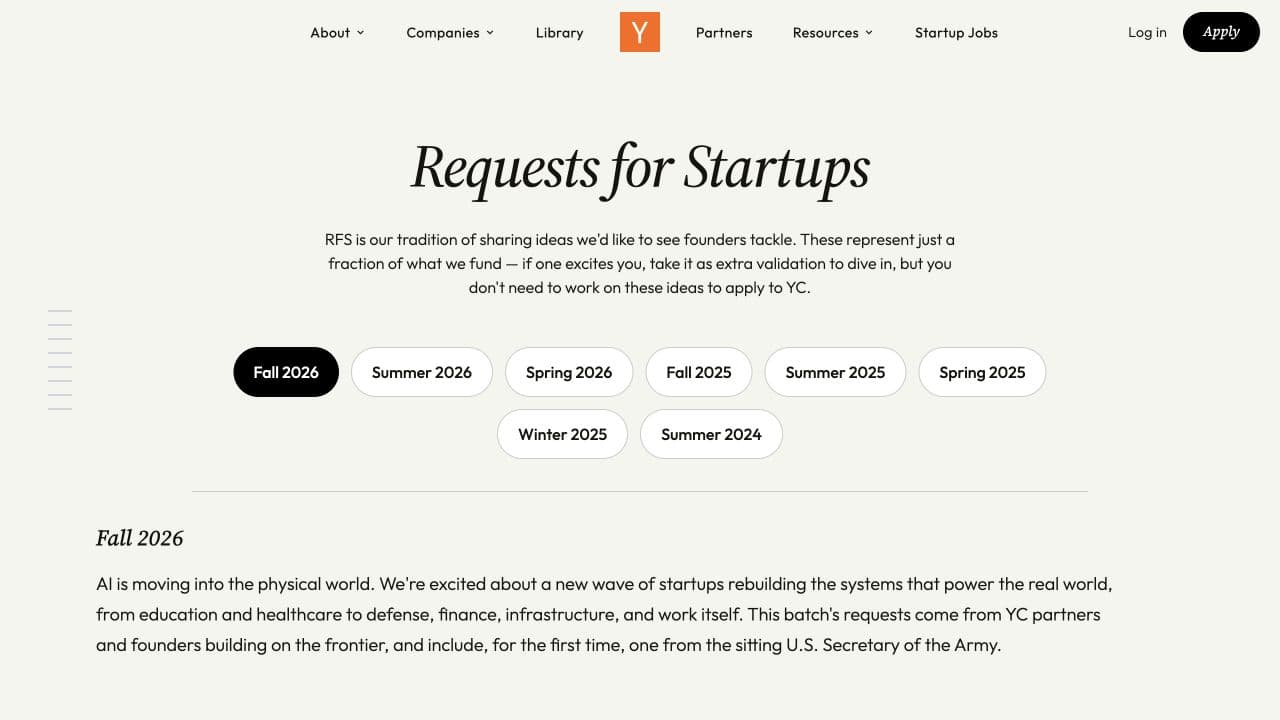
From the Fall 2026 edition, I have selected five directions: adaptive one-to-one learning, multiplayer AI agents, deploying and sharing small software, elder care, and field operations. The learning theme also resonates with Andrew Ng's new company, LearnVector.
What would these products actually do, why would people need them, and where could a founder start? The family, sales, and maintenance scenarios below are hypothetical product explorations, not delivered customer cases.
The Primer: Remembering How a Person Learns
The Primer can be understood as an AI tutor that grows alongside a child. YC proposes adaptive foundational education, beginning with reading, writing, and arithmetic, to support teachers rather than replace them.
The important question is what the system adapts to. If a child struggles with fractions, is the difficulty understanding parts and wholes, or simply making a calculation error? The former might call for an example about dividing objects; the latter might require calculation practice. A different question, completed independently afterward, would help establish whether the explanation worked.
I am especially interested in whether a product can connect learning sessions. Last week's misunderstanding, this week's progress, and examples that resonate with the learner should influence the next lesson. Parents should see not just time spent, but what their child has mastered and where help is needed. That turns one-to-one interaction into a teaching process, rather than merely a chat format.
LearnVector is exploring a related direction. On July 28, 2026, Coursera announced a $100 million investment in the company, founded and led by Andrew Ng. Its announcement describes a personalized, one-to-one learning experience.
LearnVector's website describes jointly planning a learning path, adapting pace and explanations, and supporting learners through mastery. Its emphasis is on acquiring a skill, not merely finishing a course.
The two directions are not identical. YC's proposal begins with children's foundational learning, while LearnVector's public description also addresses work goals and skill development. The company is still developing its product, with its website anticipating a first look in early 2027. These are product ambitions, not yet demonstrated educational outcomes.
For training businesses, the distinction is practical. Imagine a new salesperson who finishes a product course but cannot answer a customer's follow-up questions. A focused practice product could rehearse those conversations, record recurring mistakes, and let a manager validate improvement in real work. Courses still matter, but the customer ultimately needs someone who can perform the task.
Multiplayer AI: Colleagues Working with the Same Agent
Multiplayer AI concerns several people participating in an agent's task. YC's Aaron Epstein argues that AI has not yet had its multiplayer moment.
This is different from a multi-agent system, in which several agents coordinate behind the scenes. Multiplayer collaboration concerns colleagues jointly intervening in, adjusting, and handing over the same task. Both can coexist, but they are not interchangeable.
Consider a team preparing a customer proposal. Sales contributes the budget, a technical lead confirms implementation conditions, and a delivery lead adjusts the schedule. Separate AI chats may produce three inconsistent proposals. A collaborative product should keep people working on the same task and make relevant changes visible to both colleagues and agents.
If a customer requests an earlier launch, the system could identify affected milestones and ask the delivery lead to confirm, rather than committing the company automatically. The person taking over should be able to see earlier promises and unresolved conditions without reconstructing dozens of messages.
I would start narrowly, perhaps with the workflow from customer requirements to a formal proposal. Shared editing, a record of decisions, and explicit responsibility handoffs can be tested against reduced rework. That is a clearer value proposition than a general-purpose corporate group chatbot.
A Cloud for Small Software: A Tool Colleagues Can Still Open Tomorrow
YC's A Cloud for Small Software addresses deployment and sharing for tools built by individuals and small teams.
A store manager might build a useful scheduling tool with AI. But a colleague needs to install an environment to run it, or the data disappears when someone changes computers. Those obstacles can send a promising prototype back into an unused folder.
A product could begin inside one company. An employee creates a tool and receives a working link; access can be revoked when someone leaves; a broken update can be rolled back. These are delivery requirements I would test, not claims that every existing product already offers them. The point is to reduce everyday friction, not make business users learn software operations.
Companies may not buy a separate system for every small tool, but might pay for an environment that keeps those tools working reliably. Founders still need to determine whether custom support consumes the revenue and who bears responsibility for errors in the tools' business logic.
Elder-Care AI: Start with Everyday Coordination
YC's elder-care direction includes voice interaction, safety assistance, and care coordination. I would begin with a daily problem faced by a family, rather than an all-purpose care robot.
Suppose an older parent changes an outing plan. A daughter knows, but the son arranging transport does not. A product worth exploring could connect an accessible voice interface with a shared family calendar: the parent describes a change, the system repeats it for confirmation, then notifies the relevant person. The test is whether the parent uses it and the family needs fewer follow-up calls, not how human the voice sounds.
Sending a reminder is not the same as someone handling it. What happens without acknowledgment? How are recognition errors corrected? Which relatives may see which information? These questions need answers before deployment. An ordinary reminder tool must not be mistaken for a dependable emergency service.
This is a smaller ambition than a general robot, but it offers a concrete starting point with families and service providers. The reason to pay should be perceptible: fewer omissions, fewer wasted trips, and care arrangements that someone actually picks up.
Field Operations: When Is a Repair Ticket Really Finished?
YC also proposes new operating systems for the physical world, including coordination in construction and maintenance.
Creating a repair ticket does not mean a problem is on its way to resolution. The equipment model may be wrong, a part unavailable, or the reported fault inaccurate. Each information gap can cause another site visit.
One product hypothesis is to have AI organize photos, equipment details, and maintenance history before dispatch. An engineer confirms uncertainties, then prepares the required materials. After the repair, the system records the remedy and acceptance result so the next person facing a similar fault has something useful to consult.
The outcome to measure is not report-writing speed, but whether first-visit resolution improves and repeat trips decline. Industry specialists may know better than general software teams which missing information costs the most. Turning that expertise into a product still requires testing whether it works consistently across engineers and customers.
From a Theme to a Customer Willing to Pay
What interests me about these five themes is that each invites a more concrete question. Can learners perform independently? Does collaboration reduce rework? Do small tools keep working? Does someone take responsibility for a care arrangement? Can a repair be completed in one visit? Specific questions make products easier to test.
I would not rush to rank the largest market after reading the list. If you already work in education, enterprise services, elder care, or equipment maintenance, start with a customer you know and follow a frequently troublesome process from beginning to end. The detail you understand may be closer to a business opportunity than another sweeping AI concept.
This article was interpreted by Lincoln based on YC RFS Fall 2026, LearnVector, and Coursera's official announcement. The original article consulted these materials on September 11, 2026. YC does not state an exact publication date. This is an interpretation of selected themes, not a translation of the entire list. Discussion of entrepreneurship and financing does not constitute investment advice.
About MindsLeap
MindsLeap is an enterprise AI transformation and AI-native startup acceleration platform. It supports traditional enterprises adopting AI and AI-native companies, one-person companies, and technology founders connecting with industry use cases, capital, Silicon Valley resources, and global markets.
MindsLeap is a global partner of Founders Space. Through the MindsLeap Founders AI Club, AI training, advisory, FDE implementation, and startup acceleration, it helps enterprises move from AI awareness to practical business implementation.
MindsLeap connects founders, AI engineers, industry specialists, investors, and global innovation resources to support AI adoption across workflows, organizational capabilities, product innovation, and growth.
This article was translated and adapted from the Chinese original with AI assistance.