Author: Lincoln Wang | Founder & CEO, MindsLeap | Partner and CEO, Founders Space China | Founder, MindsLeap Founders AI Club
"Almost nothing you want has an interface. You don't want any products. You just want to talk to a persistent entity that can accomplish goals on your behalf."
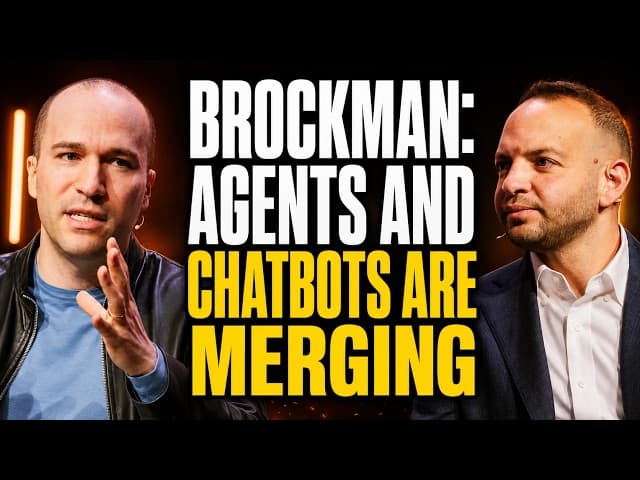
That was OpenAI President Greg Brockman, in a deep conversation with Alex Kantrowitz. This was not marketing language from a product launch — it was the underlying logic behind why OpenAI is merging ChatGPT and Codex.
What OpenAI is really building, he said, is not a better chatbot. It is building "personal AGI" — an entity that proactively thinks "what can I do for Alex today?"
Every entrepreneur building products, building organizations, or driving digital transformation should pause and think about that.
From language model to doing the work for you
Brockman recalled what ChatGPT looked like at launch in 2022: no memory, no tool connections, no context. It was just a language model — you talk, it talks back, that's it.
"Conversational intelligence is only part of what people actually need to accomplish their goals."
He compared it to early computers — a few KB of memory, incapable of doing anything. Today, models have a 52-million-token context window, can connect to hundreds of tools simultaneously, can read and write your file system, and can control your browser.
When capability changes, form must change.
Brockman gave a real example from inside OpenAI. A colleague on the communications team was organizing an event. She had Codex reach out to all attendees, collect dietary preferences, and arrange seating charts. All the manual email-sending and spreadsheet-wrangling — AI handled it. She just focused on the event's creative direction.
This is not a demo video. This is happening every day.
A super-tool called Codex
Many people think Codex is just a coding tool. The name does have "code" in it, but Brockman said: "It's really not about code. Its essence is a general-purpose agent."
He asked the audience: "How many of you have used Codex?" Not that many hands went up. But then the data he shared was surprising —
"Inside OpenAI, Codex's usage penetration is now almost as high as Slack's. OpenAI is a company that runs entirely on Slack. If you're not on Slack, you can't work. Now, the Codex App has become the same thing."
What does this mean? In a company full of engineers, non-technical staff are already using agents at scale to get work done. And the trend is exponential.
Brockman said ChatGPT handles roughly 230 million health-related queries per week. That number alone tells a story: users are not just chatting with AI — they are entrusting it with real-life decisions.
Trust is the moat of the agent era
But there is a huge question, and Brockman is aware of it.
When AI can read your email, search your calendar, draft your messages — and even send them directly — how do you decide which things to let it do and which to handle yourself?
"This introduces a very important dimension of the agent era: trust. We need to learn how to build trust with these systems — knowing where they do well, where they don't. Deciding what you're willing to delegate, how you hand over responsibility."
He defined trust as "earned, not granted." Not OpenAI saying "you can trust me," but providing enough tools, controls, and oversight capabilities for users to gradually build trust.
This sounds abstract, but it is extremely concrete. Imagine: your AI drafts an email. Mode one — it asks for your confirmation before sending. Mode two — it sends directly. Are you willing to move from mode one to mode two? When? How far?
That boundary is the core of product design. And the core of enterprise agent adoption.
The competitive landscape after interfaces disappear
During the interview, the host brought up Apple's new Siri — another intelligence layer sitting on top of all your apps. ChatGPT will also be an app on iPhone. Will they collide head-on?
Brockman's answer was interesting. He said that when capability reaches a new magnitude, you get the chance to rethink everything — how people interact, what technology can do.
He gave an example: doctors have already published papers documenting how they used OpenAI's o3 model to find diagnostic directions for patients who had gone undiagnosed for years. "The smarter the model, the faster science advances. That's a completely different dimension from a model that helps you book travel and organize your calendar."
He didn't directly answer the Apple competition question. But he implied something: when interfaces themselves are no longer the moat, what truly differentiates is underlying capability, domain expertise, and ecosystem collaboration.
Interestingly, Brockman mentioned that when OpenAI approached partners saying "we want to train AI to be really good at using your software," the response was unexpected: "This is the most friendly partnership outreach we've ever received." Because when AI becomes proficient with a tool, usage of that tool explodes.
This is not a zero-sum game. At least not yet.
A future that is already happening
Toward the end, the host brought up two stories that had gone viral: GitLab's CEO got cancer — he ran every diagnostic test available, fed the data to AI, paired it with a purpose-built app, and gained a degree of control over his condition. And an Australian dog named Rosie — its owner did a biopsy, ran mutation analysis with AlphaFold, used a chatbot to help design an mRNA vaccine, injected it, and the tumor shrank.
Are these isolated cases?
Brockman's answer: "Absolutely going to become the norm. Absolutely."
He also mentioned his wife has multiple health issues. "I don't know how we'd be managing her conditions without these tools."
This is not Silicon Valley self-congratulation. This is happening. 230 million people per week query ChatGPT about health. People are uploading scan results. People are comparing contradictory medical opinions.
"We've always lived in a world where patients weren't empowered. Patients have to be their own doctors. You're the final decision-maker. You bear all the consequences. When a doctor makes a mistake, you pay the price for the rest of your life."
AI may be changing that structural problem.
When the entry point becomes intelligence itself
Back to the original question: what does it mean that OpenAI is merging ChatGPT and Codex?
It means the future entry point may not be an app, an operating system, or a browser. The entry point is the conversation between you and the agent. All software interaction flows through this entry point.
Brockman says this is not an operating system — it is "an entirely new way you interact with technology."
For entrepreneurs, this means at least three things to reassess: If your product is a tool that requires users to click buttons, will its value be covered by a thinner conversational interface? What work in your organization can agents take over — not in the future, but with capability that exists today? When your customers start using AI to make decisions, how do your products and services need to show up in front of AI — not just in front of humans?
Interfaces are disappearing. Trust is being built. Capability is growing exponentially.
This map is just starting to unfold. And some people have already walked very far on it.
About MindsLeap
MindsLeap is an AI-native organization transformation accelerator.
In deep partnership with Silicon Valley innovation incubator Founders Space, MindsLeap connects cutting-edge global AI insights, the Silicon Valley tech entrepreneurship ecosystem, and real-world transformation scenarios for Chinese entrepreneurs.
MindsLeap is building a transformation ecosystem for entrepreneurs, startup founders, AI engineers, industry experts, and investors — helping enterprises move AI from awareness, strategy, and tools into organizational capability, business processes, product innovation, and growth systems.
This article was translated and adapted from the Chinese original with AI assistance.