Author: Lincoln Wang | Founder & CEO, MindsLeap | Partner and CEO, Founders Space China | Founder, MindsLeap Founders AI Club
"You don't have to be the smartest person in the room. AI has all the answers."
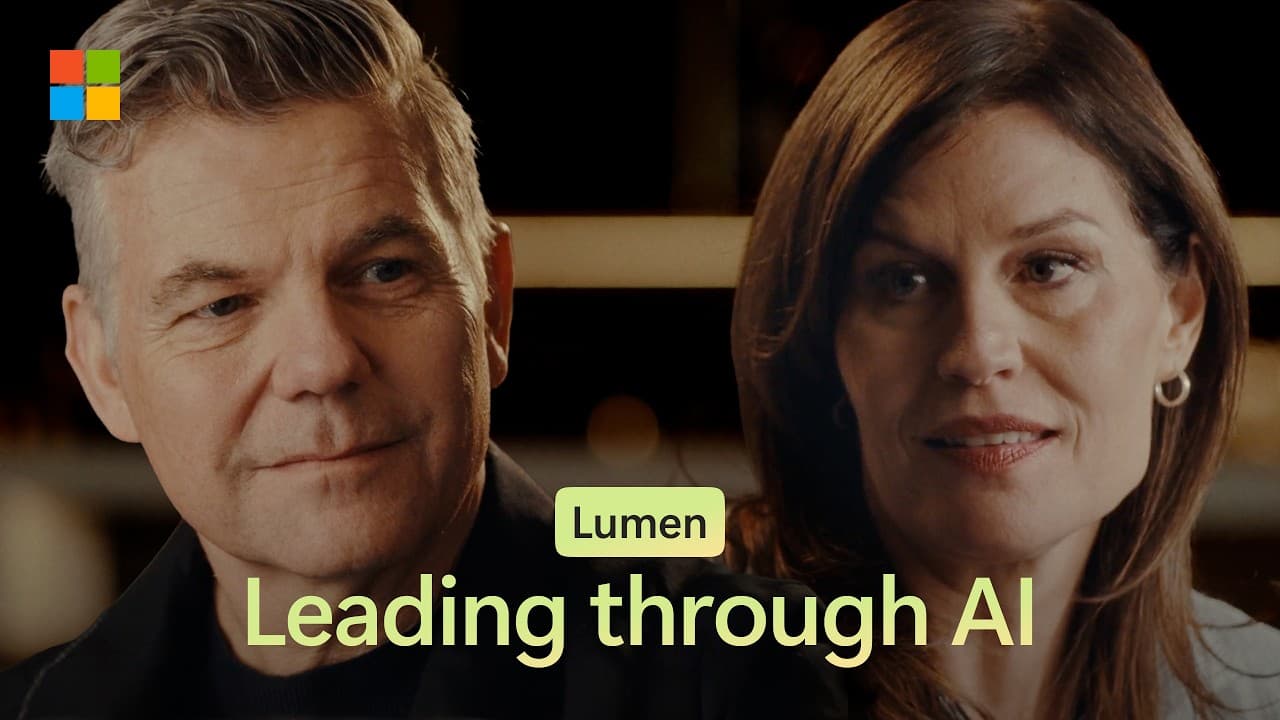
The person saying this is Ana White, Chief People and AI Enablement Officer at Lumen. She joined the company just as the generative AI wave was taking off, and she has lived through the shift from treating AI as an efficiency tool to making AI part of the company's external promise.
That sentence deserves attention not because it sounds elegant, but because it lands exactly on a transition most organizations are still underestimating.
From Efficiency Tool to Trust Network
Lumen is a network infrastructure company. When AI first became urgent, it started where most enterprises started: asking whether AI could improve internal efficiency. The answer was yes, but that was not enough.
The real shift came when Lumen moved AI from an internal tool to an external commitment.
Ana recalled that once the company connected its private network capabilities to the idea of trusted AI infrastructure, the organization became energized. This was no longer an HR-led internal system. It became something the company had to deliver for customers. The external promise forced internal change.
That detail matters. Many AI transformation programs stall not because the tools are weak, but because the work remains a cost-center initiative. When AI becomes part of the value proposition to customers, internal resistance changes shape.
Seventy Percent People, Thirty Percent Tools
Ana has a simple view: AI transformation is 70 percent people and culture, and only 30 percent tools.
Behind that ratio is a reality many companies keep rediscovering: tools can be purchased, but mindset cannot. Without a shift in mindset, there is no real adoption, no team confidence, and no trust.
What are employees afraid of? Ana is direct about it. They are not afraid of the technology itself. They are afraid they may no longer be needed. The question underneath the surface is: in this new world, do I still matter? What happens to my work?
That fear does not only live in Silicon Valley. It lives in mainstream America, and in the Chinese context it lives across the cities and industries far away from the technology center but central to employment.
When fear is about identity rather than skills, training has to change. The real question is not simply "how do I use Copilot?" It is "why do I still matter inside this organization?"
Instant Answers and Lifelong Judgment
AI can now produce an answer in a second. What does that mean?
It means the idea of being the smartest person has been redefined. Ana says that when AI can already generate answers, the scarce capabilities become judgment, empathy, and critical thinking.
Judgment is the ability to add context and proportion on top of an AI answer. Empathy is the ability to notice who is falling behind as the team accelerates. Critical thinking is the courage to look at a polished answer and say: wait.
These are exactly the "soft costs" that many companies spent the past two decades trying to compress. Now they are becoming hard requirements.
The Five C Framework: Pulling Debate Back to Facts
Ana shared a practical tool called the Five C framework. When two people disagree, each uses AI to work through five dimensions: color, context, consequences, connections, and cost.
Once both sides put their Five C analysis on the table, the discussion almost always moves toward a better answer.
The value of the framework is not only in those five words. Its real value is that it forces both sides to admit that they are seeing only part of the picture, and that the other person's perspective contains something they may have missed.
Ana also referenced Brene Brown's research on vulnerability and trust. In a company, this means leaders have to be willing to say, "I am not sure," and "I need your perspective." In cultures where leaders are expected to always have the answer, that is deeply counterintuitive.
The Space Between Stimulus and Response
The host asked Ana a sharp question: after walking this path, what did she get wrong at the beginning?
Her answer was about herself. Earlier in her career, she felt she had to provide an answer immediately, and with great certainty. Now she has learned to pause, leaving space between stimulus and response.
"I pause now. I use AI. I use collective wisdom. But I pause more than I used to, and I lead with more curiosity rather than with a predetermined answer."
This is a very concrete shift in leadership. It is a move from fast decision-making to careful integration. In an age when AI can produce answers instantly, speed itself is no longer the advantage. The person who can control the rhythm becomes more valuable.
Pause When You Win
Ana also mentioned a habit that organizations often overlook: celebrating wins.
Companies have a familiar weakness. After finishing something important, they immediately jump to the next thing. Ana sees this as a drain on organizational momentum. When the team wins, pause, celebrate, and let people feel seen as a collective.
That can sound like management comfort food, but in the context of AI acceleration it has practical importance. When work cycles compress from years to quarters, and from quarters to weeks, human fatigue compounds quickly. Without intentional pauses, the organization quietly overdraws itself.
Back to the Map That Is Still Unfolding
Ana's story points to a simple but increasingly validated idea: AI transformation is ultimately a transformation of trust. There is evidence that organizations that get culture right perform roughly twice as well as those that focus only on technology.
What does this mean for Chinese entrepreneurs?
First, do not outsource AI transformation to the IT department or a consulting firm. It is a CEO-level agenda because the core variable is the mindset of people and the trust structure of the organization.
Second, when evaluating an AI project, ask a different question: will this project make our team more dependent on one another in a healthy way, or more isolated? If the answer is the latter, the project will probably be hard to scale.
Third, and most importantly, when AI can provide all the answers, your role is no longer to be the person with the answer. Your role is to decide what question should be asked, when the team should pause, and who needs to be brought into the conversation.
That is much harder than writing a prompt. It is also why leadership becomes more important, not less, after AI has all the answers.
Source Note
This article was interpreted by Lincoln based on Microsoft's official video Lumen's people-first playbook for the AI age | On the Frontier, published on June 9, 2026.
About MindsLeap
MindsLeap is an AI transformation accelerator that helps traditional entrepreneurs find transformation paths in the AI era. In partnership with Silicon Valley incubator Founders Space, MindsLeap connects technology founders with real customers and scenarios, links domestic and international capital with the Silicon Valley technology ecosystem, and supports China's industrial AI transformation and global expansion.
This article was translated and adapted from the Chinese original with AI assistance.