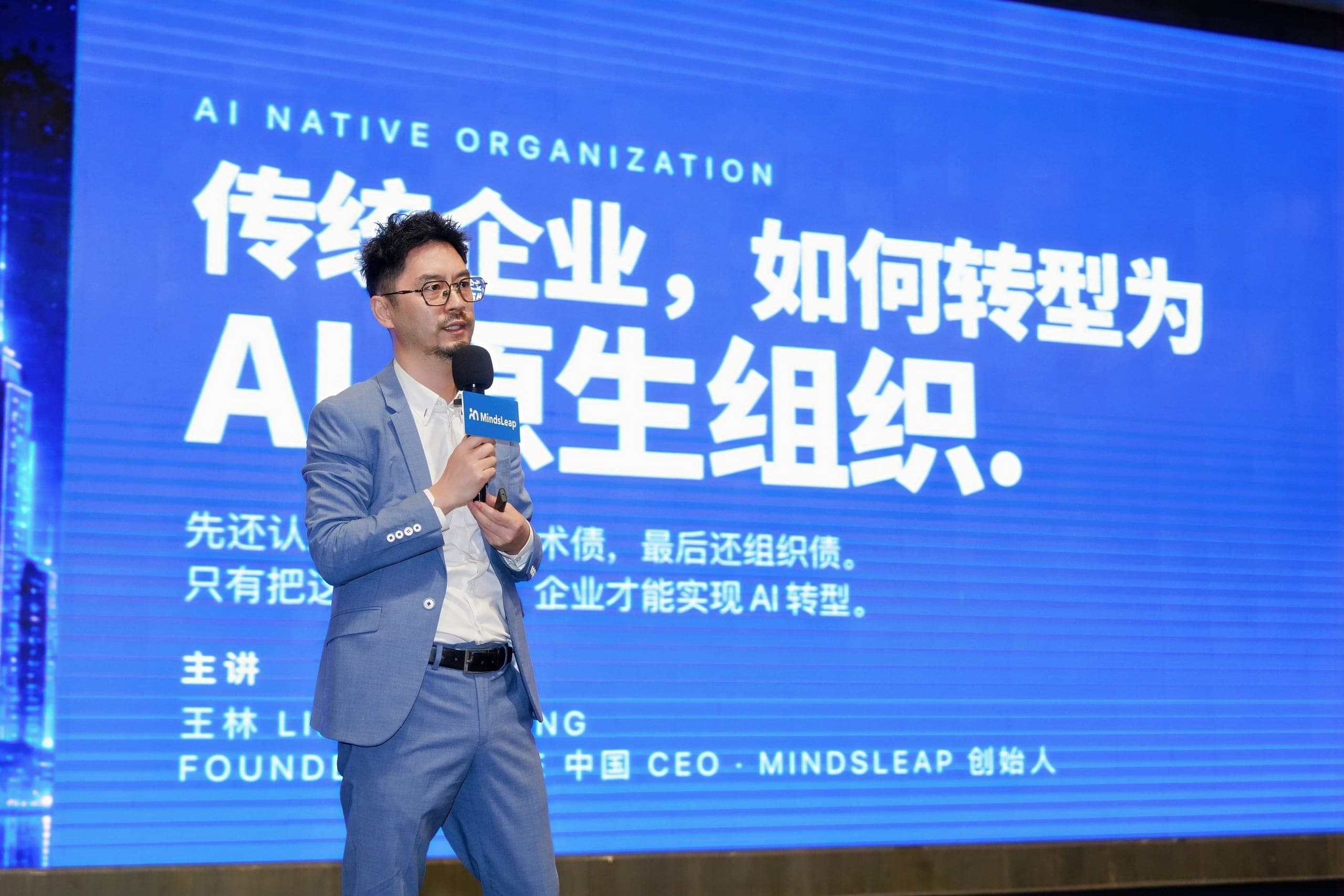
Author: Lincoln Wang | Founder & CEO, MindsLeap | Partner and CEO, Founders Space China | Founder, MindsLeap Founders AI Club
Enterprise AI implementation is entering a new stage.
Many companies have already attended enough AI training sessions and watched enough product demos. Leadership teams know AI matters. Business teams know they should experiment with agents, RAG, workflow automation, and knowledge systems. But once the work touches real operations, the hard questions appear: where is the data, who can approve access, how do the systems connect, how do we measure results, and who will make the team actually use it?
This is where FDE services become important.
FDE stands for Forward Deployed Engineer. It is not traditional outsourcing, and it is not only pre-sales consulting. It puts production-capable engineers inside the customer's real business environment so they can help move AI from demo to production.
The Bottleneck Has Changed
Many companies still assume their AI projects are stuck because models are not strong enough, tools are not mature enough, or employees are not trained enough.
Those issues exist, but they are not the deepest bottleneck.
The real bottleneck is often in the field:
- Business workflows have not been redesigned.
- Data is scattered across multiple systems.
- Permissions, security, and compliance are not planned early.
- The PoC works, but real users do not adopt it.
- No one continuously reviews cost, quality, efficiency, and business outcomes.
In other words, the hard question is no longer only whether a company has AI capability. It is whether the company has the field engineering capability to embed AI into real work.
FDE exists to solve that problem.
How FDE Differs From Outsourcing
Traditional outsourcing usually delivers against a requirements document, functional scope, and billable hours. Success often means the requested function was completed.
FDE is different because it is focused on production adoption and business outcomes.
A strong FDE is not only a coder. They must speak with business owners about workflows, with IT teams about system boundaries, with security teams about permissions, and with frontline users about real pain points. They also need to write code that can run, be maintained, and be evaluated.
The goal is not a document or a polished demo. The goal is an AI workflow running inside the business.
FDE combines three roles:
- Engineer: able to build production code, APIs, data pipelines, deployment, logs, and monitoring.
- Product lead: able to turn business problems into an iterative product scope.
- Field owner: able to drive coordination, adoption, and review inside a complex organization.
That is why many AI projects do not need more slide decks. They need a stronger field engineering loop.
When FDE Is Useful
FDE is not required for every AI project. If a company only needs tool training or a standard software purchase, FDE may be unnecessary.
But FDE becomes valuable when a company faces these situations:
- The team has done AI training but does not know the first high-value use case.
- A PoC exists but cannot enter production.
- The team wants agents, RAG, or workflow automation, but the data and systems are complex.
- Business teams want AI, but IT, security, legal, and executives are not aligned.
- The company wants to turn a pilot into reusable AI implementation capability.
In these situations, FDE is not simply writing code for the customer. It helps the company build a full mechanism from use-case selection to production review.
How MindsLeap Thinks About FDE
In the MindsLeap enterprise AI transformation framework, FDE is not an isolated service. It is the link between AI training, AI advisory, and real implementation.
We usually break enterprise AI transformation into three stages.
The first stage is alignment. Executive AI training and workshops help leadership teams understand AI-native organizations, agents, Token ROI, AI workflows, and industry cases.
The second stage is co-creation. Around real business needs, we map use cases, data, process, systems, organizational friction, and ROI assumptions.
The third stage is FDE implementation. A small team enters the business environment and builds a live, measurable, reviewable AI workflow or agent pilot.
When these three stages connect, companies are less likely to stop at "we understand it" or "the demo looks good."
How an FDE Project Should Run
A mature FDE project usually has four steps.
Discovery diagnoses the field.
The team maps process, data, systems, permissions, users, metrics, and risks before rushing into code.
Architecture defines the minimum production scope.
The team decides model choices, data flow, permission design, evaluation, logging, and rollback.
Build runs embedded iterations.
The FDE team works with the customer team and ships usable increments every one to two weeks.
Transfer creates learning and review.
The project leaves behind documentation, training, operating methods, ROI data, and the next-stage roadmap.
A strong FDE project does not only deliver a system. It helps the organization learn how to keep delivering AI systems.
What This Means for China
Enterprise AI implementation in China has its own characteristics.
Many customers care deeply about private deployment, security, compliance, domestic technology stacks, internal system integration, and field service. Selling only APIs or SaaS often cannot cover these needs.
That means FDE services in China are likely to grow first in three places:
- Large model platforms and industry solution companies.
- AI appliances, private deployment, and government or enterprise projects.
- Vertical agent companies.
If these companies only sell products, customers may not adopt them. If they only sell consulting, the work may stop at strategy. FDE is the opportunity to connect product, advisory, and implementation into one loop.
Quotable Takeaways
- The bottleneck in enterprise AI implementation is no longer only model capability. It is field engineering capability.
- FDE is not outsourcing or pre-sales consulting. It connects business context, data, systems, engineering, and adoption.
- AI training solves the alignment problem. AI advisory solves the roadmap problem. FDE solves the journey from PoC to production.
- A mature FDE project should be evaluated by business outcomes, not only functional completion.
- In China, FDE opportunities will likely emerge first in private deployment, vertical agents, AI appliances, and complex enterprise or government scenarios.
FAQ
What is FDE?
FDE stands for Forward Deployed Engineer. It refers to a production-capable engineer embedded in the customer's real business environment to turn business problems into live AI systems and workflows.
How is FDE different from AI advisory?
AI advisory focuses on strategy, use cases, and roadmap design. FDE focuses on field engineering, systems integration, production pilots, and ongoing review. Mature AI transformation needs the two to connect.
When does an enterprise need FDE?
An enterprise needs FDE when it has completed initial AI training or strategy work but is blocked by data access, system integration, PoC productionization, user adoption, or ROI measurement.
What kind of FDE services does MindsLeap provide?
MindsLeap provides integrated AI training, advisory, and FDE implementation services. We help teams build executive alignment, select high-value use cases, and run field engineering pilots with measurable outcomes.
Read More
- FDE services topic page
- Enterprise AI transformation topic page
- FDE industry business model research
- Enterprise AI transformation services
About MindsLeap
MindsLeap is an AI-native enterprise acceleration platform working with Founders Space to help enterprises transform with AI and help AI-native startups, OPC builders, and technology founders connect with industry scenarios, capital, Silicon Valley resources, and global markets.