Author: Lincoln Wang | Founder & CEO, MindsLeap | Partner and CEO, Founders Space China | Founder, MindsLeap Founders AI Club
"Some of the biggest companies of the next decade won't be software businesses. They will be services companies, like insurance carriers and law firms, rebuilt from scratch with AI doing most of the work."
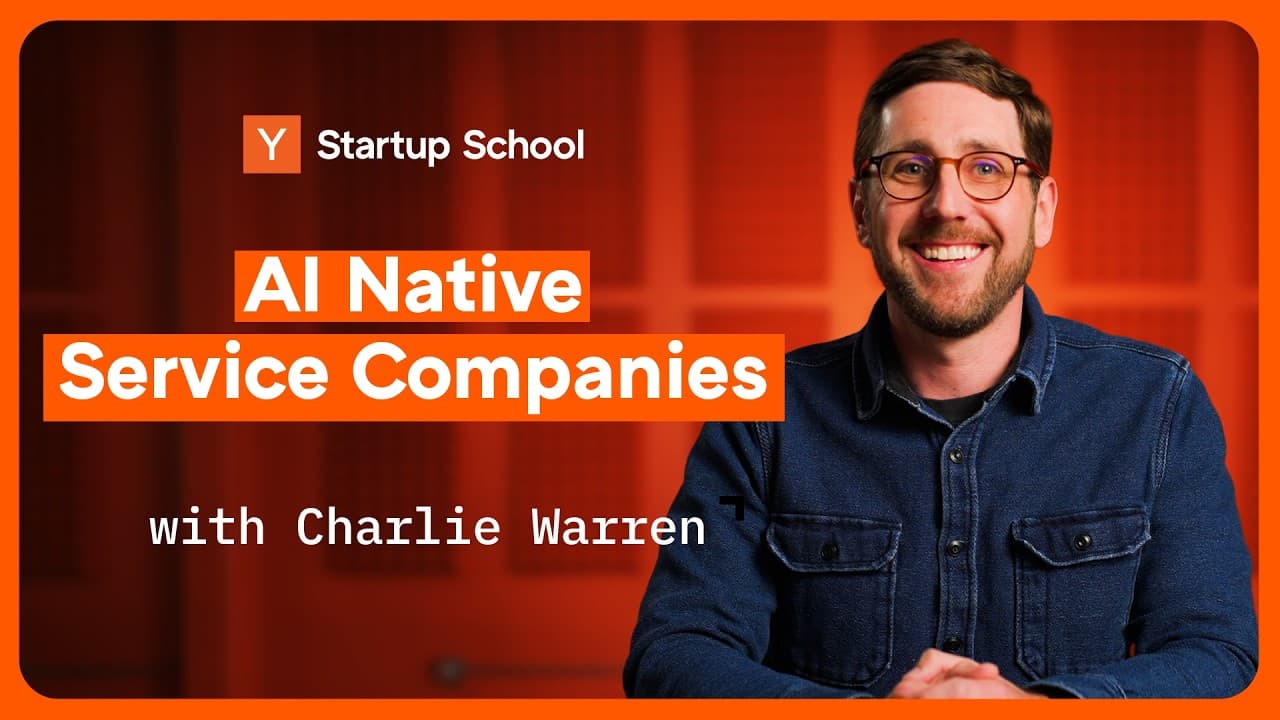
That was the core judgment in a Y Combinator Startup School talk for founders. The speaker did not focus on model architecture or show a flashy demo. Instead, he pointed to a category that the software industry has long underestimated: tax, audit, insurance, mortgages, healthcare compliance, and other service industries where trillions of dollars still move through human-heavy processes.
Over the past two years, many AI startups have done the same thing: add a copilot to an existing workflow. YC is pointing to another path that is starting to form: do not sell tools; deliver outcomes. Do not make the customer's employees work a little better; do the work for the customer.
That is not a small adjustment to SaaS. It is a different business logic.
Customers Do Not Care How the Work Gets Done
YC's first market-selection rule sounds counterintuitive: choose a low-trust market.
Low trust does not mean customers do not trust you. It means customers already do not care very much who does the work or how it is done. They care whether the final output is correct. Tax filing, insurance claims, FDA submissions: these jobs have been outsourced for decades. Customers are used to signing off on results, not watching every step of the process.
That means you do not need to persuade customers to change behavior. You go to a place where the budget already exists and say: I can do this better and cheaper.
"You are not asking customers to do something fundamentally different. You show up where they already spend money and do the work."
For SaaS founders, this is a cognitive reversal. SaaS sales cycles are long because you ask customers to buy a new tool, train employees, and change workflows. AI-native services companies do not have to cross that same gap. The customer was already outsourcing; you are simply a new provider.
Most Steps Must Be Automatable
The second rule is subtler: task-level judgment should be low, but the overall job should have a high intellectual bar.
At first, that sounds contradictory. But the distinction matters. If every step requires expert judgment, the process cannot scale. You want a workflow where most steps can be automated once decomposed, while human experts remain at the key review points.
At the same time, the whole job must be difficult enough that a simple model API call cannot do it. It should require a real combination of models, software, and human expertise to produce an output the customer accepts.
If the job is too simple, it has probably already been automated. If every step requires an expert, adding AI will not save much.
The right category is work that is complex overall but decomposable locally. Tax audit is like this. The rules for processing a single document may be clear, but a complete audit report coordinates hundreds or thousands of steps. That is the zone where AI agents can matter and human experts still remain essential.
Regulation Can Be a Moat
Another important YC point: regulation can be a good thing.
Regulated industries have higher compliance requirements and legal responsibility, which raises the barrier to entry. For later competitors, that can create a wider moat.
YC mentioned Panacea, a company that provides FDA regulatory services for biotech and medical device companies. It is not replacing regulatory experts with AI. It hires experienced FDA consultants, pairs them with an AI platform, and delivers faster, higher-quality approval materials.
That detail matters. AI-native services companies are not eliminating industry knowledge. They are reconfiguring how that knowledge is used. An FDA expert who used to handle 10 projects a year may be able to handle 50 when paired with AI agents. That change in output per expert is where the margin comes from.
The Process Is the Product
One line from YC is worth repeating: treat the process as the product, and the product as the process.
In SaaS, the product is a piece of software that exists separately from the customer. The customer buys it and uses it. In an AI-native services company, the product is the process that delivers the outcome. You do not need to give the customer a login screen, dashboard, or operating manual. You give them a promise: send us the request, and we will return the result.
That also explains why these companies charge by outcome rather than by seat. The customer is not buying access to a tool. The customer is buying completed work.
Why You Should Not Buy an Old Company
YC explicitly warned against one temptation: buying an existing services company and layering AI on top to shortcut revenue growth.
"You cannot buy product-market fit."
Traditional services companies have different cultures, performance systems, hiring standards, and expectations. Acquisition means inheriting old habits. Adding AI on top of those habits does not automatically change the underlying logic.
Unless you urgently need a regulatory license, such as an insurance license, you should almost never take that path. Building from scratch is usually better.
For traditional entrepreneurs who are used to acquisition and integration, this is a hard but important point. AI is not a coating that can be applied to an old process. It requires the organization and workflow to be designed from day one around what AI does and what humans do. The habits of the old company may be exactly the resistance you need to avoid.
Rewriting the Profit Structure
YC gave a specific financial frame. Traditional services companies often hit a margin ceiling around 30 percent. Pure software and agent companies can have higher margins, but their markets may be smaller. The AI-native services bet is that AI operating leverage can push margins closer to software-like levels, above 50 percent, while entering a market two to three times larger than software.
The key is not whether every company can achieve that today. The key is whether the growth trajectory is credible. Investors will likely evaluate these businesses by operating profit sooner than founders expect, rather than only ARR or user growth.
The Signal for Chinese Entrepreneurs
The most important part of the YC talk is not the list of industries that might work. It is the deeper shift it reveals: AI is blurring the boundary between software companies and services companies.
Over the past 20 years, Chinese entrepreneurs have become familiar with the SaaS language: subscriptions, ARR, NDR, PLG. AI-native services companies use a different language: delivered outcomes, outcome-based pricing, operating margin, process as product.
For traditional companies thinking about AI transformation, this may be more imaginative than building an internal AI tool. You do not have to persuade the entire company to change its habits first. You can begin with a narrow wedge: an outsourced process with clear rules and verifiable outcomes. Then build an "AI agents plus experts" delivery system from scratch.
But the condition is real. You must be willing to design the process around AI from day one, not place an AI label on top of an old workflow.
YC said this category is still early. But early does not mean unimportant. When printing first appeared, the people who saw its value were not the ones trying to make scribes copy faster. They were the ones who rethought how a book should be produced.
Source Note
This article was interpreted by Lincoln based on Y Combinator's official video How to Build an AI-Native Services Company, published on June 3, 2026.
About MindsLeap
MindsLeap is an AI transformation accelerator that helps traditional entrepreneurs find transformation paths in the AI era. In partnership with Silicon Valley incubator Founders Space, MindsLeap connects technology founders with real customers and scenarios, links domestic and international capital with the Silicon Valley technology ecosystem, and supports China's industrial AI transformation and global expansion.
This article was translated and adapted from the Chinese original with AI assistance.