Author: Lincoln Wang | Founder & CEO, MindsLeap | Partner and CEO, Founders Space China | Founder, MindsLeap Founders AI Club
From GPUs to the Grid
In June 2026, NVIDIA published a developer blog with a direct title: designing production-ready battery energy storage systems for AI factories. The authors are engineers who work on power architecture, energy storage, and grid interconnection.
The article is not about chips, models, or inference speed. It is about batteries, inverters, telemetry, control strategies, and how a facility that consumes hundreds of megawatts can coexist with the power grid.
What makes the article important is not that NVIDIA is now talking about batteries. It is the deeper judgment underneath it: the boundary of the AI factory is extending from computation into every control node of the power system. When intelligence is manufactured industrially, power infrastructure is no longer a background utility. It becomes part of the production system.
That reversal is worth thinking about for every entrepreneur.
AI Factories Behave Differently from Traditional Data Centers
Traditional data centers run diverse and gradual workloads. Different applications consume resources at different times, and the overall power curve is relatively smooth.
AI factories behave differently.
They run power-dense training and inference workloads, increasingly supporting AI agents and reasoning models. Computing demand can shift sharply over short periods of time. The facility behaves more like a giant computational engine: power-intensive, fast-changing, and deeply coupled with onsite generation, UPS systems, and energy storage.
The NVIDIA article makes a direct point: as accelerated computing campuses scale, operators are finding that power is no longer only a capacity issue. It is a control, quality, and interconnection issue.
That means simply bringing more cables to an AI factory is not enough. When load changes in seconds or even milliseconds, upstream grids and onsite generation need a buffering mechanism to absorb those disturbances.
BESS Is Not a Giant Power Bank
Battery energy storage systems, or BESS, can sound like giant power banks: charge them, store energy, discharge when needed.
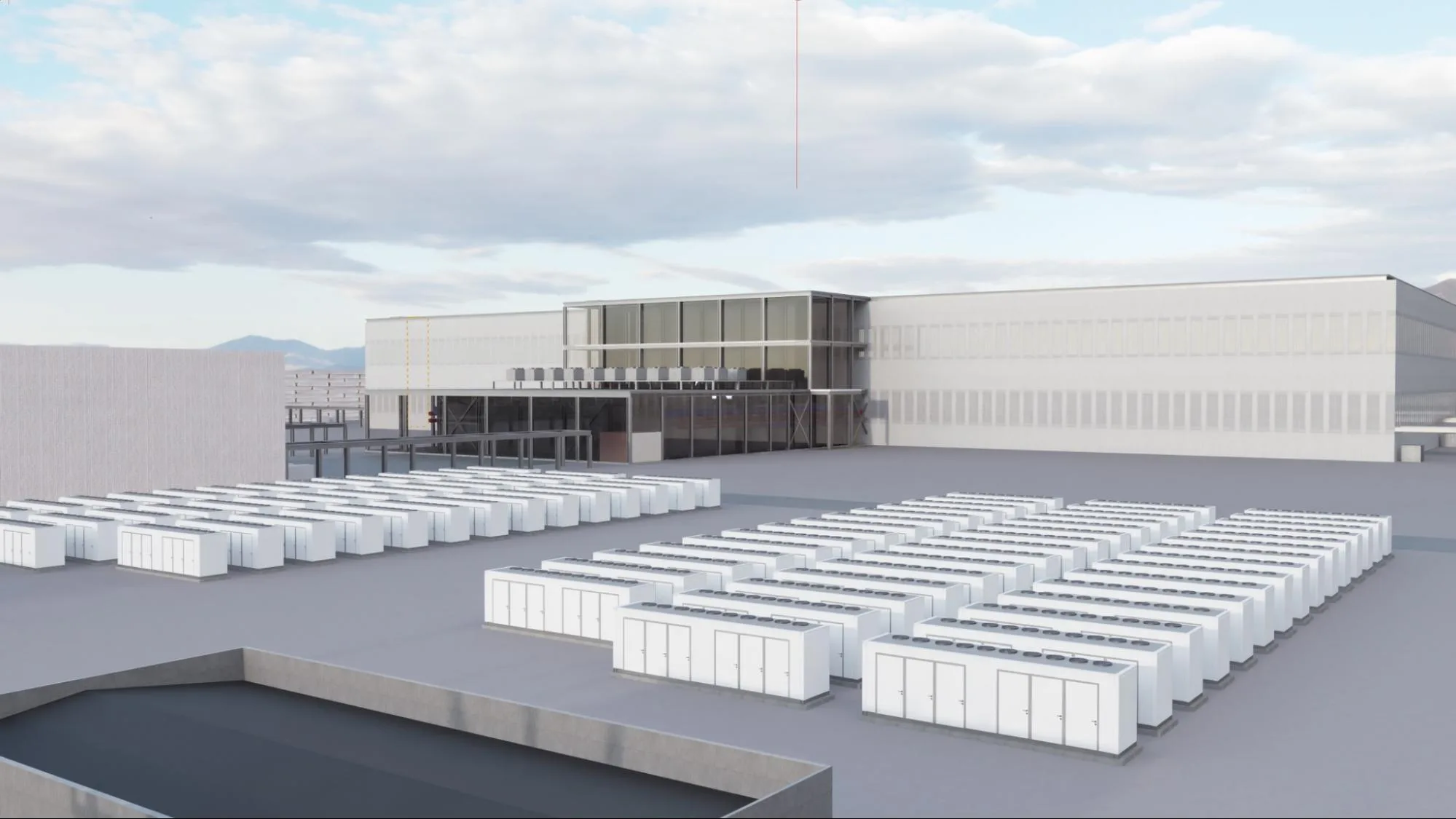
NVIDIA's engineers define them differently. A BESS combines battery cells, power conversion systems, inverters, advanced telemetry, and dynamic control strategies. Batteries store energy, but inverters and control systems let the whole system interact with the grid.
In other words, BESS is an intelligent, controllable power asset. It is not a passive energy reservoir.
Inside an AI factory, BESS can buffer rapid load swings, improve power quality, support low-voltage ride-through, coordinate with onsite generation, enable smoother source transfers, and present utilities with a more stable and grid-friendly load profile.
It can integrate with natural gas engines, fuel cells, and solar PV as a general-purpose buffer. As AI factories switch between grid-connected operation, coordinated onsite generation, and islanded operation, BESS can bridge those modes, support black start, and participate in voltage and frequency regulation.
At first, this sounds like a narrow electrical-engineering detail. But it does not stop there.
Grid Interconnection Waiting Time Is Becoming a Deployment Gate
As AI factories scale toward hundreds of megawatts and beyond, power availability is becoming one of the biggest constraints on deployment.
The constraint is not simply cable thickness. New AI factories can exceed the capacity of the existing grid. Transmission headroom, generation queues, and substation delivery timelines are tightening.
The traditional answer is to wait in line for grid upgrades. That can take a long time.
NVIDIA points to another path: properly modeled and coordinated BESS can help turn a data center into a more flexible and controllable load, unlocking constrained grid capacity. Many utilities and independent system operators have introduced accelerated interconnection paths for sites that provide load flexibility.
Put simply, an AI factory without BESS may face a longer wait for power approval because it is harder to integrate cleanly into the electrical system. A well-designed BESS can help the site get energized faster.
For time-sensitive companies, that is not just a technical optimization. It is a business decision.
Design Is More Than Sizing Batteries by Megawatt-Hour
If the value of BESS is control rather than storage alone, its design cannot be reduced to "how many megawatt-hours do we need?"
The article is explicit: the design challenge is far more complex than sizing a battery by megawatt-hour.
Battery cells, power conversion systems, controls, telemetry, modeling, fault response, and state-of-charge strategy all need to be designed together. Site models must represent the behavior of the computational load itself, including IT and non-IT load behavior, ramp rates, expected minimum and maximum demand, power factor, UPS modes, protection settings, reconnect logic, onsite generation behavior, and BESS controls.
Fast telemetry, real-time analytics, and control architectures capable of acting on that data must sit at the center of the design. Key signals include voltage, current, active power, reactive power, frequency, state of charge, alarms, and limit status.
BESS may be asked to handle transient stability, ride-through reserves, demand response, and generator coordination at the same time. Those missions can compete, so design requires explicit priorities and state-of-charge strategy.
One sentence is worth dwelling on: the AI factory is a new type of infrastructure, and existing standards do not yet cover every required behavior.
A standards gap means each deployer must build its own validation system, accumulate evidence, and define what predictable system behavior really means.
Evidence Matters
NVIDIA's answer to the standards gap is BESS self-qualification guidance. The guidance helps vendors demonstrate capability against AI-factory-specific requirements and gives data center developers more confidence in adoption.
What does qualification cover? Whether BESS supports AI load buffering, demand response, ride-through, grid-connected and islanded configurations. Validation should include as-built model verification, functional testing across operating modes, SCADA and telemetry checks, protection and control setting validation, and coordination with utilities, system operators, and nearby generation owners.
Evidence includes hardware test data and model-based analysis.
The article is blunt: if a capability is claimed, it must be supported by evidence.
But there is a second half: device-level qualification does not automatically guarantee stability of the whole site. Integration still matters.
A system that passes device-level qualification but cannot be manufactured at the required scale, maintained efficiently, or supported by robust quality processes is not ready for production infrastructure.
What This Means for Entrepreneurs
Why should entrepreneurs read an article about battery energy storage?
Because AI factories reveal a larger structural shift.
Over the past few years, startup conversations about AI infrastructure have usually centered on chips, models, and cloud. NVIDIA's article points to a less glamorous next bottleneck: power availability, interconnection, load smoothing, telemetry, control strategy, and evidence that system behavior is predictable.
Every company moving AI from demo to production will eventually face its own version of the AI factory problem. When AI agents enter real business flows, the hard problem is no longer model capability alone. It becomes control systems, integration, evidence, recoverability, and operational discipline.
This does not mean every company should build an energy storage plant. It means the deep end of AI transformation is not about who connected to a large model first. It is about who can embed intelligence into a controllable, verifiable, recoverable production system.
NVIDIA including power infrastructure inside the AI factory architecture is not diversification. It is redefining the boundary of AI production.
Source Note
This article was interpreted by Lincoln based on NVIDIA Developer Blog article Designing Production-Ready Battery Energy Storage Systems for AI Factories, published on June 10, 2026.
About MindsLeap
MindsLeap is an AI transformation accelerator that helps traditional entrepreneurs find transformation paths in the AI era. In partnership with Silicon Valley incubator Founders Space, MindsLeap connects technology founders with real customers and scenarios, links domestic and international capital with the Silicon Valley technology ecosystem, and supports China's industrial AI transformation and global expansion.
This article was translated and adapted from the Chinese original with AI assistance.